
A Call to Recover Our Common Humanity
The National Church Leaders Forum (NCLF) is committed to amplifying Black Christian voices in the United Kingdom. We join many across the country in expressing our profound sadness at the death of Professor Jason Arday, and we extend our prayers and deepest condolences to his family, friends, colleagues, students, and all who mourn his loss.
Professor Arday’s life and achievements inspired many, particularly young Black people, who saw in his journey possibilities that had too often seemed beyond their reach. His remarkable academic trajectory rightly earned national and international recognition and raised important questions about access, opportunity, and representation in British higher education.
Much has been written and said about Professor Arday in recent weeks. There are serious questions that rightly fall within appropriate academic and institutional processes. NCLF does not seek to prejudge or adjudicate those matters. Truth and integrity matter, and legitimate processes of accountability must be respected. However, accountability must extend beyond the individual.
Professor Arday’s life and humanity should be considered within the wider academic system in which his career, identity, achievements and public profile were formed. Universities are not neutral environments. They are institutions with cultures, expectations, hierarchies, systems of recognition, and established ways of determining academic credibility, advancement and belonging. Individuals exercise personal agency within these environments, but they do so within structures that both enable and constrain them.
We therefore believe that any adequate account of what has occurred must consider not only individual actions but also the institutional ecology surrounding them.
The academic institutions and systems that recruited, supported, promoted, celebrated, evaluated, and subsequently scrutinised Professor Arday must be willing to reflect on their processes, decisions, responsibilities, and cultures. Until those institutional dimensions have been fully examined, an extraordinarily complex human and institutional story may be reduced to the actions or alleged failures of a single individual.
This does not remove personal responsibility, nor should structural analysis be used to avoid legitimate questions about individual conduct. Individual and institutional accountability are not competing explanations. Both must be open to examination.
At the heart of every controversy is also a human being and their loved ones. NCLF is increasingly concerned about a public culture in which legitimate scrutiny can become a public spectacle, accountability can give way to humiliation, and the complexity of a human life can be compressed into allegations, headlines and social-media commentary.
There is also a deeper question about power: who has the authority to define the public meaning of another person’s life? Institutions, academic communities and the media possess considerable power to confer recognition, legitimacy and status. That same power can profoundly reshape how an individual is subsequently perceived. We must therefore be attentive not only to those being scrutinised, but also to the processes and institutions through which reputations are constructed, contested and sometimes dismantled.
Christian faith teaches us that human dignity is not earned through achievement, status, academic recognition, or even moral perfection. Every person bears the image of God and therefore possesses inherent dignity that must be respected, including, perhaps especially, in moments of controversy, scrutiny, and failure.
We are consequently challenged to ask not simply who is right or wrong, but what kind of society and what kind of institutions we are creating together. Justice requires truth and accountability, but justice does not require the destruction of another person’s humanity.
We therefore ask a difficult but necessary question:
Can we become a society capable of pursuing truth and accountability without destroying people in the process?
Professor Arday’s death should also prompt universities, academic institutions, the media, churches and wider society to reflect seriously on the environments we create for people experiencing intense public scrutiny.
For Black people occupying prominent institutional spaces, there are additional questions that cannot be dismissed. We must ask whether scrutiny is always proportionate; whether racialised assumptions can influence how credibility, competence, failure and wrongdoing are interpreted; and whether individuals from historically underrepresented communities sometimes bear additional burdens of representation and expectation.
These questions should neither assume racial causation in any allegation nor exclude it from legitimate examination. Race need not explain everything to remain structurally relevant.
We must therefore be willing to ask more searching questions. Who is presumed to belong in elite academic spaces? Who is readily recognised as having academic authority? Whose unconventional journey is celebrated, and whose is treated with suspicion? Who understands the unwritten rules of academic advancement? Who has the networks, relationships and institutional knowledge needed to navigate those systems successfully? And what happens when an individual with considerable public and institutional recognition becomes the subject of serious scrutiny?
These are not arguments against accountability. They are arguments for more comprehensive accountability.
Truth matters. Integrity matters. Evidence matters. Institutional responsibility matters. And compassion matters too.
Our society urgently needs spaces where people can be challenged without being dehumanised; corrected without being discarded; investigated without being prematurely condemned; and supported when the weight of institutional and public judgement becomes overwhelming.
We must also resist two equally inadequate responses to Professor Arday’s life: hagiography and condemnation. Neither uncritical celebration nor wholesale repudiation offers a sufficient account of a complex human life. Nor should either replace careful examination of the academic ecosystem in which that life and career developed.
Perhaps, therefore, the lasting question arising from this tragedy is not only what happened to Professor Jason Arday, but also what happened around him, what institutional conditions shaped his journey, and what we are learning about ourselves and the systems we have created.
Human flourishing requires more than access and opportunity. It requires communities and institutions capable of holding together truth, justice, mercy, responsibility and compassion. It also requires institutions sufficiently mature to examine their own exercise of power, rather than locating responsibility exclusively with individuals.
As Christian leaders, we recommit ourselves to helping build such a society: one in which the dignity of the human person is never compromised; in which allegations can be properly investigated and the truth pursued; in which institutions as well as individuals are accountable; in which racialised and structural realities can be examined without predetermined conclusions; and in which justice and mercy are understood not as opposites but as essential dimensions of our common humanity.
Professor Jason Arday’s humanity must remain greater than any single account of him. Equally, the academic system in which his remarkable journey unfolded must be both permitted and required to give a full account of itself.
May Professor Jason Arday rest in perfect peace, and may all who loved him know comfort, strength and peace in their grief.
ENDS
Note to editors:
For more information, please contact info.nclf@gmail.com or 0207 117 2637
NCLF co-chairs
Pastor Ade Omooba MBE 07956 007150
Dionne Gravesande-Walcott 07901 852953
Welcome to the Summer Edition of the NCLF Newsletter
Dear NCLF Friends and Supporters
Welcome to our Summer 2026 NCLF newsletter – and what a season it is.
Not only are we celebrating Father’s Day and Windrush Day but we also have the FIFA World Cup – a remarkable reminder of how sport can bring nations and peoples together. Yet, we are still grieved by the violence taking place so close to home. In moments like these, we are called to be light in the darkness.
In response to the rising community tensions, NCLF has issued an official statement, which you will find on page 3. We encourage you to read and share it widely.
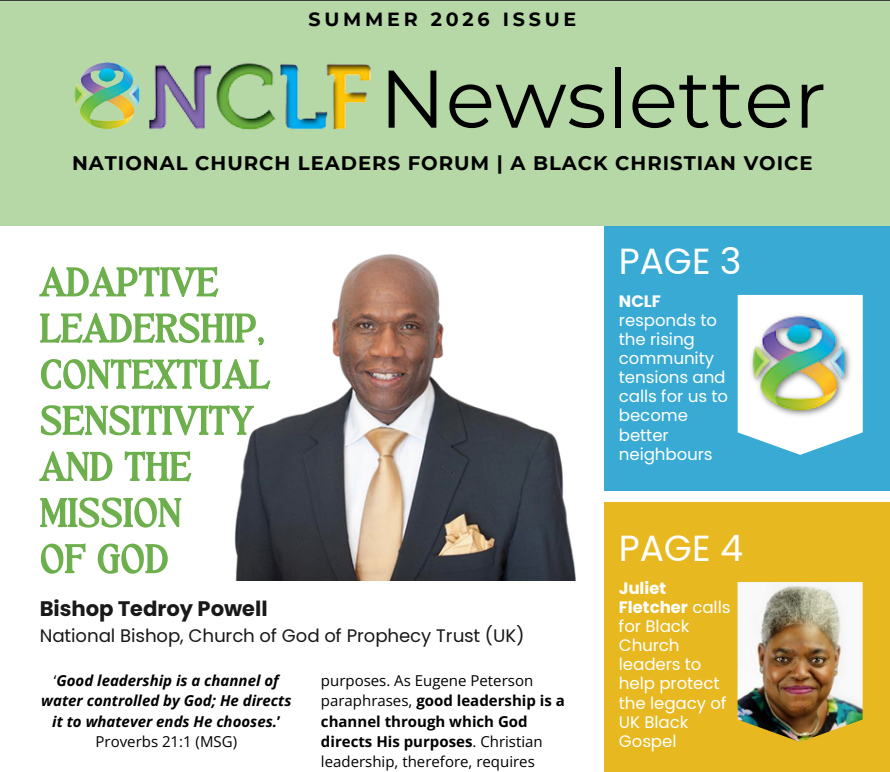
In this issue, Bishop Tedroy Powell, National Bishop of the Church of God of Prophecy Trust (UK), offers timely insight on leadership; Juliet Fletcher brings a stirring call to Black Church leaders on the legacy of UK Black Gospel; and Paul Johnson, our Digital Shepherd, writes on the importance of sovereign stewardship for our churches. As this is an extended edition, you will also find a selection of summer events, along with a screening opportunity for church and ministry leaders – details on page 6.
We hope this issue blesses, informs and encourages you. If you have news, a testimony or a story that will encourage the wider Black Church community, we would love to hear from you. The deadline for submissions is 17th August.
As always, we welcome your contributions and continued support.
God bless
Jackie Raymond
On behalf of
The NCLF Team
National Church Leaders Forum – A Black Christian Voice
National Church Leaders Forum (NCLF) Statement on Community Cohesion, Race and Belonging
Blessed are the peacemakers, for they will be called children of God.” (Matthew 5:9)
Recent scenes of unrest, violence, racial terror and division witnessed in parts of our natio have caused deep concern and sadness. As church leaders, we lament the fear, anger and pain being experienced by many communities across the United Kingdom.
We recognise that many people are facing significant pressures. Rising living costs, economic uncertainty, pressures on housing and public services, and concerns about the future can create anxiety and frustration. These concerns are real and deserve to be heard and addressedwith honesty and compassion.
We also recognise that questions relating to immigration, asylum, integration and community cohesion are complex matters that governments and society must address with wisdom,fairness and humanity. It is both legitimate and necessary in a democratic society to discuss these issues openly and respectfully. However, such discussions must never be used to justify hostility, discrimination or violence towards individuals or communities.
At the same time, we reject any attempt to direct that frustration towards individuals or communities because of their race, ethnicity, nationality, faith, or immigration status. Racism, hatred and violence are incompatible with the teachings of Jesus Christ and have no place in our communities.
We affirm the inherent dignity and worth of every human being, each created in the image of God. Throughout our history, Britain has been shaped by people from different backgrounds, cultures and experiences who have contributed to the flourishing of our shared society.
Black communities carry a long history of navigating questions of migration, identity, belonging and discrimination. From these experiences emerge lessons of resilience, faith, hope and community-building that can help guide our nation through this difficult season.
We are concerned by the growth of misinformation, inflammatory rhetoric and narratives that seek to divide neighbour from neighbour. We encourage all people to seek truth, reject stereotypes, and engage one another with humility and respect. Complex challenges relating to immigration, housing, public services and community cohesion require thoughtful and evidence-based discussion rather than fear, scapegoating or political point-scoring.
In this season the Church has a vital role to play. We are called to be peacemakers, bridge-builders and ministers of reconciliation. Our churches are places where people can encounter welcome, belonging, honest conversation and practical support.
We therefore call upon church leaders and congregations across the country to:
Pray for peace, healing and wisdom in our communities.
• Stand in solidarity with those who feel vulnerable, targeted or afraid.
• Create opportunities for meaningful conversations across differences of race, culture and background.
• Challenge racism, prejudice and misinformation wherever they arise.
• Work alongside civic leaders, politicians, community organisations and people of goodwill to strengthen community cohesion and mutual understanding.
Our prayer is not simply for the absence of conflict, but for the presence of justice, understanding and genuine neighbourliness. At a time when many are asking, “Who belongs here?”, we believe the better question is, “How can we become better neighbours to one another?”
We encourage government, civil society, faith communities and local leaders to engage in honest and respectful dialogue about the challenges facing our nation, including immigration and integration, while resisting the forces of hatred and division that undermine our common life.
As the National Church Leaders Forum, representing Black Majority Churches and Christian leaders from across the United Kingdom, we offer this contribution from a tradition shaped by faith, perseverance and service. For generations, Black churches have stood at the heart of local communities nurturing families, supporting young people, caring for the vulnerable and strengthening social cohesion. Having journeyed through our own experiences of migration, exclusion, belonging and contribution, we remain committed to working with all communities to build a nation where every person is valued, every voice is heard, and every neighbourhood can flourish. We stand ready to partner with churches, politicians, civic leaders and communities in the shared task of building a more just, compassionate and united Britain.
ENDS
Note to editors:
For more information, please contact info.nclf@gmail.com or 0207 117 2637
NCLF co-chairs
Pastor Ade Omooba MBE 07956 007150
Dionne Gravesande-Walcott 07901 852953
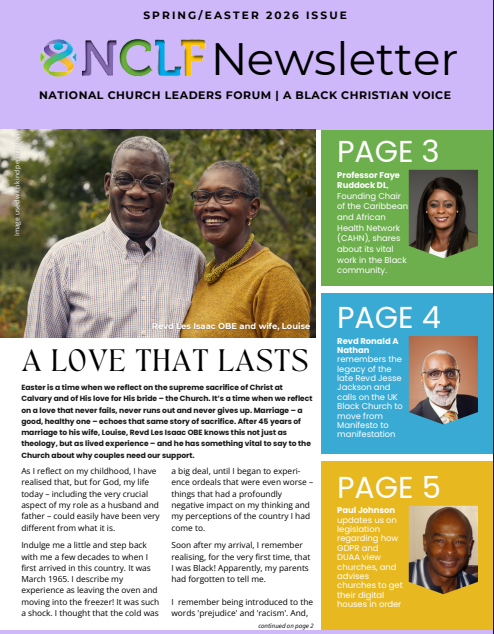
Welcome to the Spring Edition of the NCLF Newsletter – Our Easter Issue!
Dear Friends,
Easter is fast approaching and we fix our eyes again on Jesus – our living Hope, who is risen and triumphant. With His victory over Death and hell comes the joy of new beginnings, renewed faith and the assurance of eternal life. We have much to be grateful for, despite the wars and rumours of wars.
In this issue, we are blessed to have Revd Les Isaac OBE, who is soon to be celebrating his 45th wedding anniversary with wife, Louise. He writes compellingly about why the Church must champion and support marriage – not just for church members but for church leaders, too. His is a voice of both wisdom and experience.
We are also pleased to hear from Professor Faye Ruddock, founding Chair of the Caribbean and African Health Network (CAHN) on its vital work tackling inequalities around Black health care in the UK. Revd Ronald A Nathan reflects on the life and legacy of the late Revd Jesse Jackson, and Paul Johnson – the Digital Shepherd – brings an important reminder about GDPR and DUAA compliance.
We hope this issue of the NCLF Newsletter encourages and equips you. May the hope of the risen Christ carry you into a joy-filled Easter season.
Blessings
Jackie RAYMOND
NCLF News
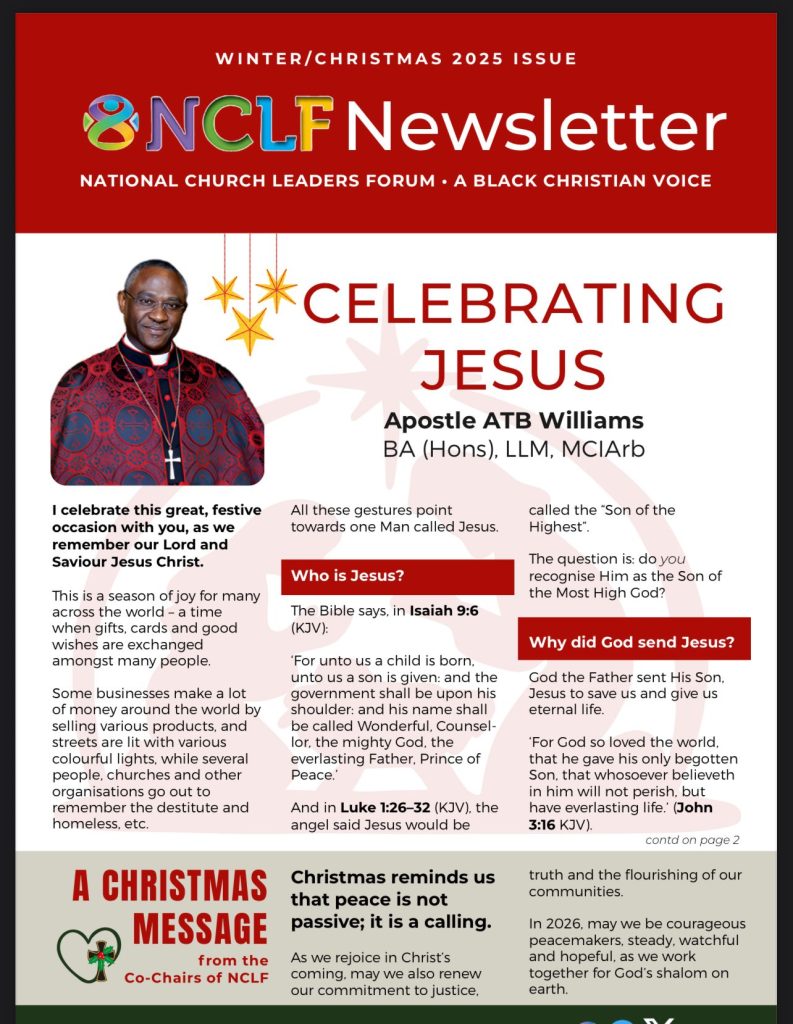
Welcome to the Winter Edition of the NCLF Newsletter – Our Christmas Issue!
Dear Friends and Supporters,
As we come to the close of 2025, we invite you to pause and reflect. How has this year been for you ?
Whether you have achieved all the goals you set in January or are still trusting God for breakthroughs, we can be grateful for His grace and for His perfect timing. He gives us the strength we need to run our race and He enables us to keep pace with His purpose.
‘Let us run with endurance the race that is set before us, looking to Jesus, the founder and perfecter (finisher) of our faith…’ (Hebrews 12:1-2a). ‘Let us hold fast the confession of our hope without wavering, for He who promised is faithful’ (Hebrews 10:23).
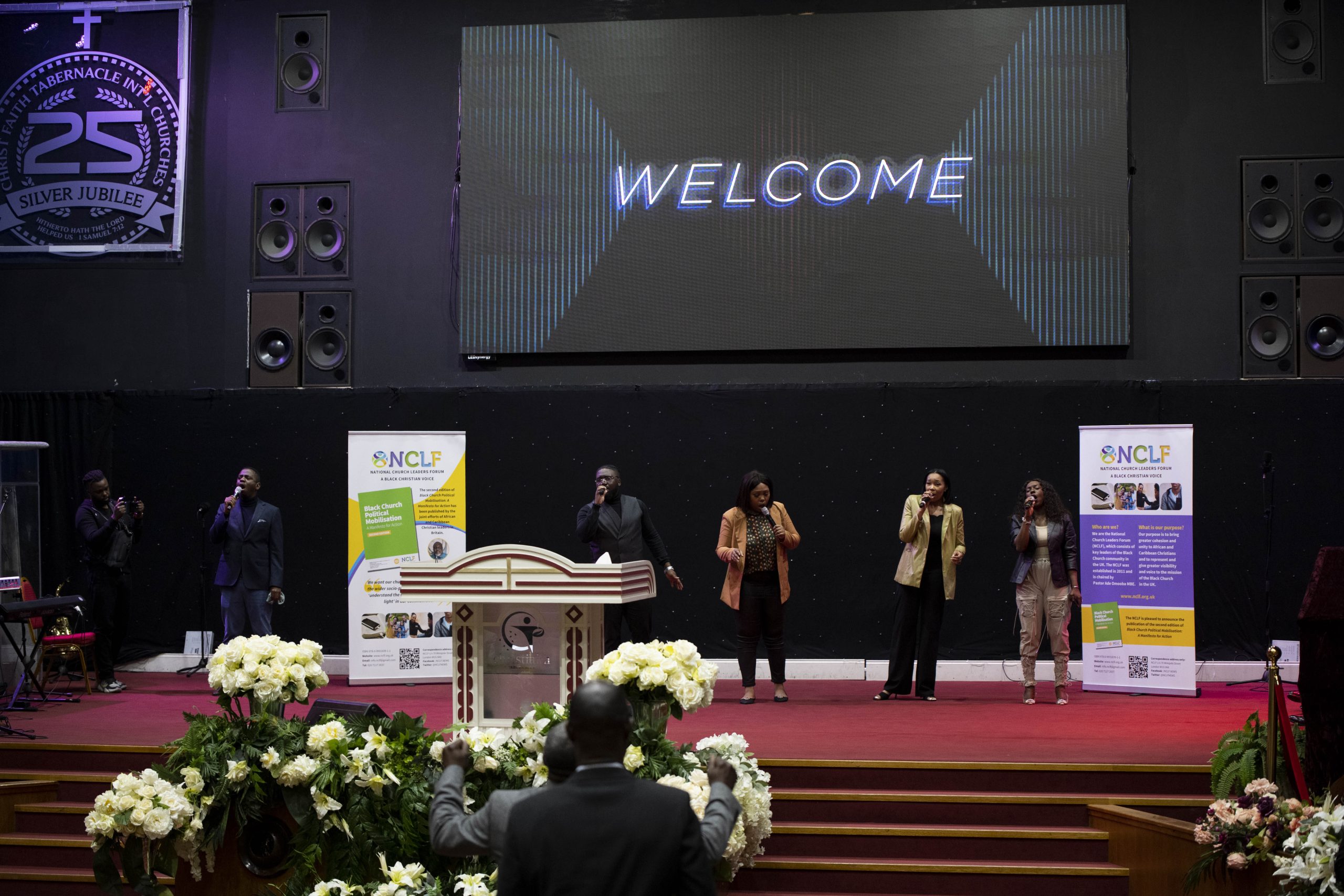
In this Christmas issue, you will find an uplifting Christmas message from Apostle Alfred TB Williams, Presiding Bishop and General Overseer of Christ Faith Tabernacle International Churches, reminding us of the wonder of our Saviour’s coming.
We also hear from Dr Joe Aldred, who brings a timely and sobering reflection on oppression, and from Elsa Caleb who shares an inspiring update on NCLF fundraising – including practical ways you and your church can partner with us to impact communities across the UK.
Finally, Paul Johnson of ChurchGOers Ministries updates us on the Digital, Enterprise and Mentoring (DEM) initiatives and highlights opportunities for you to get involved.
We hope you enjoy this Newsletter. Thank you for your continued prayers and financial support. May you, your loved ones and your church family experience the peace and joy only Jesus can give – not just this Christmas season but throughout the year ahead.
Have a wonderful Christmas.
God bless you
Jackie RAYMOND
NCLF News
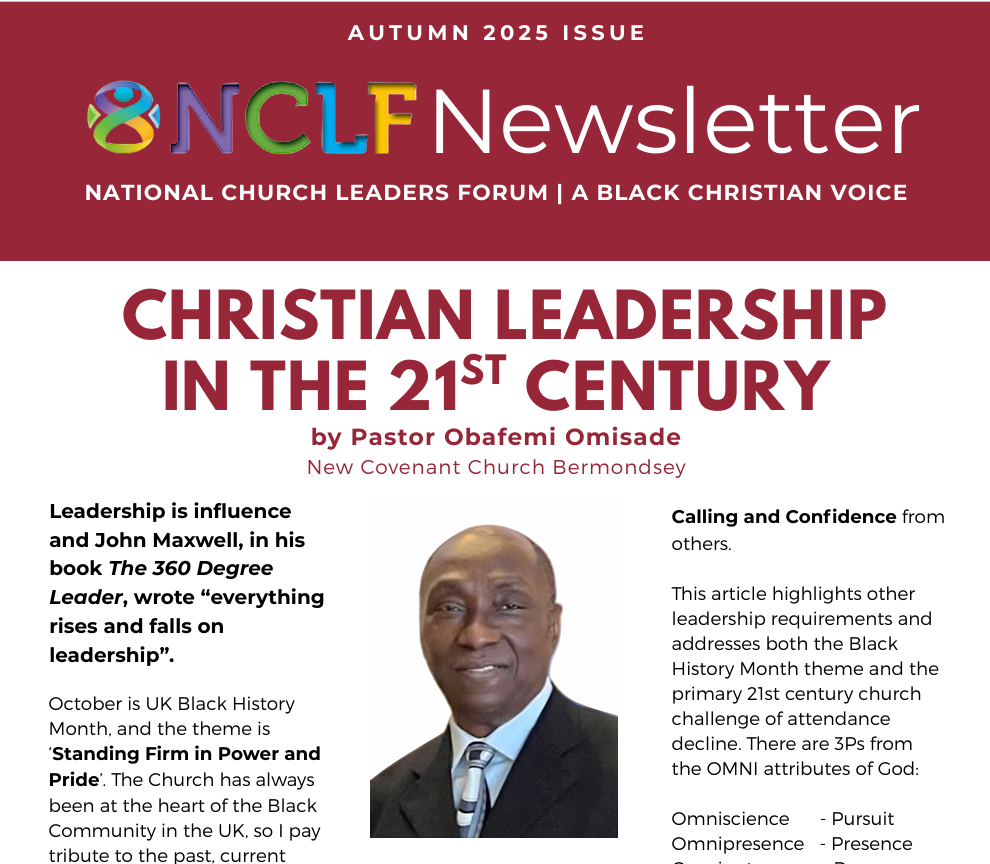
Welcome to the Autumn Edition of the NCLF Newsletter.
Dear Friends and Supporters,
I’m sure you’ll agree with me that this year is already flying by and Christmas is nearly upon us. If you have been intentional with your year so far, that’s great news, but all is not lost if you haven’t been. There are still a few weeks to go before New Year’s Eve.
In the meantime, we have much to be thankful for.
In this edition, we are blessed with an article written by Pastor Obafemi Omisade of the New Covenant Church in Bermondsey, where he talks about leadership. Rev Ronald A Nathan examines the reasons why climate justice should matter to Black Christians, and we have news from Co-Chair Dionne Gravesande of how NCLF is working with the Racial Justice Advocacy Forum.
We are living in strange times, but we need to keep looking ahead, unto Jesus, the Author and Finisher of our faith.
One way of looking ahead is to prepare for future leaders, and I’d like to draw your attention to an important event taking place on 26th and 27th October – the inaugural Kingdom Mentoring Discipleship Summit. Read more about from Paul Johnson, the ‘Digital Shepherd’.
We hope you find this edition informative and helpful.
God bless
Jackie RAYMOND
(on behalf of NCLF)
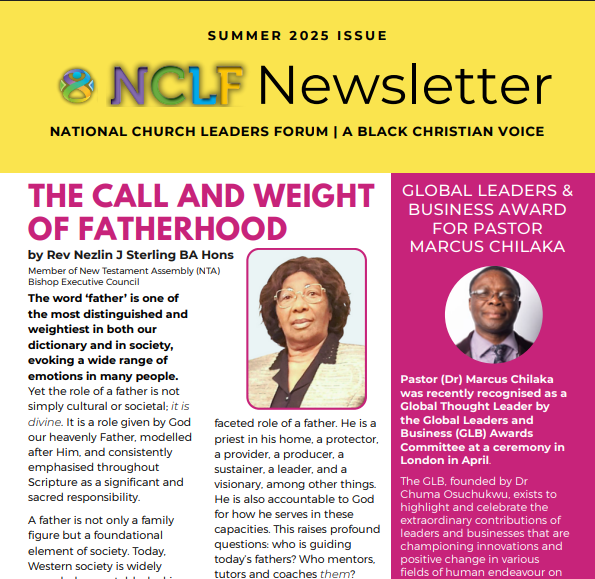
Welcome to the Summer Edition of the NCLF Newsletter.
Dear Friends and Supporters,
Welcome to the Summer 2025 edition of the NCLF Newsletter, which we are delighted to share with you.
Father’s Day and Windrush Day may seem like distant memories already, but we are blessed to have Rev Nezlin Sterling, Member of the NTA Bishop Executive Council, to reflect on the divine calling and responsibility of fatherhood, as she calls on spiritual fathers to mentor spiritual sons all year round.
We celebrate the achievements of some of our NCLF team, including Dionne Gravesande and Pastor Dr Marcus Chilaka, who both won leadership awards recently, and Bishop Dr Joe Aldred, who received a Windrush Nation Award.
‘A threefold cord is not easily broken’ and when we see Christian organisations collaborating, with Holy Spirit at the helm, success is inevitable. I’m sure you’ll be excited to read updates on the great progress being made in economic empowerment and mentoring initiatives.
These stories are a powerful reminder of what we can achieve when faith and action work hand in hand.
We hope you enjoy reading this issue, and as always, we welcome your contributions and continued support.
God bless
Jackie RAYMOND
(on behalf of NCLF)
Welcome to the Spring edition of the NCLF Newsletter.
Welcome to the Spring issue of our NCLF Newsletter, arriving as we celebrate the most profound season in our Christian calendar.
‘When all around is sinking sand…’
As economic uncertainties mount, with the recent tariffs affecting global markets, we’re reminded that our security rests not in worldly systems but in the unchanging foundation of our Lord. Regardless of “interesting times” ahead, we remain anchored to the One who neither shifts nor fails, and we stand on the Rock who neither crumbles nor sinks.
The Lord’s ultimate victory over sin and death assures us that whatever storms we face, our eternal salvation stands secure.
We’re blessed in this issue to share inspiring reflections on Easter’s transformative message from Pastor Leke Sanusi of the Redeemed Christian Church of God, and Rev Ron A Nathan of the African Methodist Episcopal Zion Church, whose insights will deepen your appreciation of this holy season.
Juliet Fletcher, Founder/Director of SongShare, writes about how this great initiative will support songwriters of Caribbean and African heritage, many of whose songs have become so integral to our praise and worship services. We also hear an encouraging update from NCLF Co-Chair, Dionne Gravesande.
We hope you enjoy this issue. May we continue to rejoice in the resurrection power that lives within us.
Christ is risen indeed, and we wish you and your loved ones a blessed and joy-filled Easter.
Jackie RAYMOND
(on behalf of NCLF)
Welcome to the Christmas edition of the NCLF Newsletter.
As Christmas and the New Year approach, we find ourselves reflecting on the many changes since our Autumn edition. From a new US President preparing for inauguration in January, to moments of turmoil across the globe, there is a palpable sense that 2025 will be a year of great significance for many.
Galatians 4:4 (AMP) says: ‘But when [in God’s plan] the proper time had fully come, God sent His Son.’ As we prepare to celebrate the birth of Christ and step into a new year, we can rest in the assurance that God’s timing is perfect. His plans for us, as promised in Jeremiah 29:11, are filled with hope and a future.
In this Christmas edition, we are delighted to share an inspiring lead article by Pastor Matthew Ashimolowo. We hope it brings encouragement and joy as you reflect on the season’s deeper meaning.

|
|
|
|
|
|
STATEMENT FROM THE NATIONAL CHURCH LEADERS FORUM UK
Blessed are the peacemakers, because they will be called sons of God” (Matt. 5:9, NIV).
In the aftermath of the terrible events in Southport, we express our deepest condolences to the families and friends of those affected by these horrendous killings. We stand in solidarity with the community during this time of profound grief and anger. We understand the intense emotions felt by many, as well as the anxiety surrounding issues of immigration.
It is deeply troubling that, in the after effects of such tragedy, mosques have been attacked and hotels housing asylum seekers set alight. We unequivocally condemn these acts of violence and hatred. Racism has no place on our streets or in our society and must not be fueled, whether in our communities or online. As leaders of the faith community, we call for unity, compassion, and understanding. Let us work together to build a society where everyone feels safe and valued, regardless of their background.
We urge all members of the community to reject hatred and violence, and to come together in peace and solidarity.
HOW TO NAVIGATE THE ELECTION LANDSCAPE AS A CHRISTIAN
“Your vote is your right; it is your authority; it is your influence. Use it well”.
Rev Ade Omooba, NCLF Co-Chair.

Picture by Kirsty O’Connor/ No 10 Downing Street
The recent UK general election saw the Labour Party secure a landslide victory, winning 412 seats in Parliament and ending 14 years of Conservative rule. On the 5th July Sir Keir Starmer, who led Labour to this historic win, became the new Prime Minister of the United Kingdom.
His campaign focused on positioning Labour closer to the political center, promising change and stability while addressing key issues such as the housing crisis and public services. The election results reflect a significant shift in voter sentiment, with the Conservatives suffering their worst defeat in parliamentary history.
For UK churches, this change in government could present new opportunities for engagement in political missions. Sir Keir’s background, which includes a commitment to public service and social justice, may align with some church priorities. However, it’s important to note that such approaches are pragmatic and centered on governance rather than ideology.
Churches may find opportunities to engage with the government’s issues such as social welfare, healthcare, and community support. The new government’s focus on revamping public services could provide avenues for churches to contribute their perspectives and resources in addressing societal needs. However, the specific impact on churches and their political engagement will depend on the policies and priorities that the new Labour government implements in the coming months.
Following the surprise General Election call, the election machines are now in full swing. Here is some information from leading Christian organisations to help you to make informed and godly decisions regarding your vote.
 LINKS ⇓
 LINKS ⇓
VOTE, PRAY AND THINK CHRISTIANLY THIS ELECTION
PRAYING FOR THE GENERAL ELECTION
PARTY MANIFESTOS :- LABOUR, REFORM, CONSERVATIVE, LIB-DEMS, GREENS, SMALLER PARTIES, FOR SCOTTISH, WELSH AND NORTHERN IRISH NATIONAL PARTIES.
 HOW SHOULD I VOTE AS A CHRISTIAN?
 THE GENERAL ELECTION IS ON 4TH OF JULY – GET INFORMED!
 CARE LAUNCHES NEW RESOURCE TO HELP VOTERS GET TO KNOW THEIR CANDIDATES FOR THE GENERAL ELECTION
 CHRISTIAN AID’S CALL TO ACTION TO UK POLITICAL PARTIES FOR GENERAL ELECTION 2024
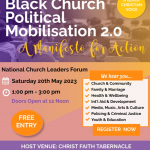
“NCLF – National Church Leader Forum is an organisation commited to facilitating a Black Christian Voice in the UK. In 2015 more than 200 Church leaders were involved in the reflection, research, collation, publication and final launch of the first ever Black Church Political Mobilisation Manifesto. Its publication coincided then with the National Election and was widely commended by the hundreds of members within the both House of Lords, Parliaments and well as government leaders, political and civic individuals and organisations of every type. The National Church Leaders Forum developed out of a meeting of key Church Leaders and Workers, Community Organisers and Business Leaders on Tuesday 10, May 2011”.